We use the secure cloud version of the Immix monitoring platform. Immix can receive alarms from a wide range of devices, which all present to the operator in a common format regardless of manufacturer.

We can monitor almost any CCTV system as long as it is compatible with Immix. Common compatible brands include Hikvision, Dahua, Videcon, Truvision, Davantis, Axis, and Avigilon, but you can view all supported systems by referring to the Immix website.
After signing in, go to MENU/Integrations/Integration Support/ which will take you to a full list of compatible devices, including helpful notes on how to set them up. If you are unsure if your devices are supported, use the Immix chatbot, email the Immix helpdesk, or call SMC.
Most connections are completed via external static IP addresses with the site’s router/network, but connections can also be done via a DNS address or VPN.
Commission time varies from site to site, depending on the site network being ready for remote connection when the engineer attends. Some sites take less than 10 minutes, while others may take a few hours.
We can receive many alerts, ranging from traditional red walls, GJDs, beams, and passive infrared (PIR) to modern onboard camera detection, including intrusion, line-crossing, and tripwire detection.
We use Calipsa to filter false alarms, which has an average 75-80% success rate. No filtering system is 100% accurate and can be relied upon to always prevent isolations from occurring.
We provide many additional services for CCTV, including remote guard tours, visual verification of internal intruder alarms, remote access (concierge) through doors and gates, intercom services, and monitored entry and exit procedures. If you have a specific requirement, please contact us to find out how we can help.
Yes, the ports required vary for manufacturers and can be obtained through SMC.
Yes, via TOUCH 2.0 and the Immix portal.
Most of the cameras we monitor are detection-activated, and alarms can be triggered by passive infrared (PIR), infrared beam, analytic detection, or any method that involves a change of state.
Once triggered, alarms are transmitted to our control room via digital video recorder (DVR) or network video recorder (NVR) over a static IP broadband line, DDNS, or VPN. We receive the video image that triggered the alarm, as well as footage from immediately before and after the event, to determine the cause (subject to your settings and requirements)
Static cameras are usually used for analytics, but PTZ cameras can be used if they remain in a fixed position, or – if moved – returned to a home position.
No, we judge all individuals as a threat and will call a keyholder as soon as an unauthorised person or vehicle is detected on site.
Please avoid bullet and static mini dome cameras unless you are installing a separate light source and will be switching off the camera’s infrared (IR) lighting.
Spiders are attracted to the warm and dry environment of the area below the rain hood, especially on bullet cameras with a sliding rain hood.
On soffit or wall-mounted static mini domes, spiders often spin webs from the wall or soffit board across the camera. Static mini domes mounted on a swan neck bracket fare better as the environment is hostile to spiders, which are washed away by rain and wind.
If you cannot avoid using on-board infrared (IR), then turret-type cameras work quite well as the IR lighting is separate from the lens, and, in general, spiders do not like turret cameras as much as other types (although, if soffit mounted, we do still get some spider issues. Separate lighting is the better choice and is the manufacturer’s recommendation.
The IR lighting around the camera lens magnifies spider silk. When the silk blows in the wind, it trips the analytics and generates unwanted alarms. See the images below for example.
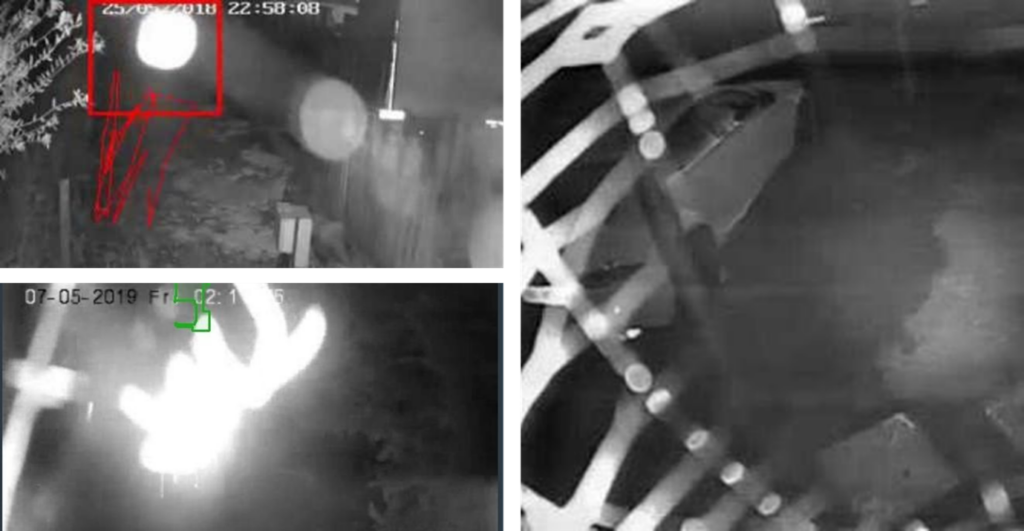
The spider itself will also generate unwanted alarms when moving across the camera; the analytics will judge it to be a person or a vehicle due to the size of the shape in motion. Please ensure your cameras are regularly cleared of spiders to avoid false alarms. We are often left with no other choice than to disable cameras due to excessive false alarms caused by spiders.
Yes, we can; please contact us to learn about our available options.
Third-party alarm receiving is when a professional monitoring centre, like SMC, receives and responds to alerts from fire, intruder, and CCTV systems installed by independent security providers. SMC’s NSI Gold-approved Alarm Receiving Centre (ARC) ensures 24/7 monitoring with immediate escalation. Learn more at https://www.smc-monitoring.com/homepage
Yes. By partnering with SMC, fire and security installers can offer full CCTV monitoring services without building their own ARC. SMC provides seamless integration for IMMIX-compatible systems and professional response through certified operators. Details at https://www.smc-monitoring.com/cctv-monitoring
Partnering with SMC allows you to connect your customers’ fire alarms to our NSI Gold ARC, ensuring alerts are verified and escalated 24/7. Explore the benefits at https://www.smc-monitoring.com/fire-alarm-monitoring
Monitored intruder alarms reduce response times, deter theft, and ensure verified escalation. SMC provides nationwide support to installers offering this service. More info at https://www.smc-monitoring.com/intruder-alarm-monitoring
SMC uses live CCTV feeds to verify alarm triggers before escalating them, significantly reducing false positives. See how it works: https://www.smc-monitoring.com/video-analytics
TOUCH is SMC’s online platform that lets installers manage commissioning, testing, and site access remotely. Get started here: https://www.smc-monitoring.com/touch-portal
Yes, SMC partners with certified guard response providers like The Keyholding Company and RSPNDR. Discover your options: https://www.smc-monitoring.com/keyholding
Absolutely. SafeZone is a mobile app integrated with SMC’s ARC that supports lone worker safety with real-time alerts and location tracking. Learn more at https://www.smc-monitoring.com/safezone
CheckMyCCTV provides automated health checks every hour, alerting installers if a system fails. Included in SMC monitoring packages: https://www.smc-monitoring.com/checkmycctv
SMC uses Calipsa AI to analyse CCTV footage and filter out false alarms caused by animals, headlights, and other harmless triggers. Learn more: https://www.smc-monitoring.com/calipsa
Yes. SMC’s TOUCH portal allows automated scheduling and tracking of VRT fire alarm tests. See how it works: https://www.smc-monitoring.com/fire-alarm-testing
These services provide secure out-of-hours access verification for deliveries and site visitors using live CCTV. Explore both here: https://www.smc-monitoring.com/site-access-services
Yes, SMC’s ARC is NSI Gold-approved and ECHO-connected for fast communication with emergency services. Accreditation info: https://www.smc-monitoring.com/homepage
RSPNDR offers app-based rapid response with performance guarantees and low monthly costs—ideal for SMEs. Compare here: https://www.smc-monitoring.com/rspndr
With Video Escort and SafeZone, SMC provides proactive monitoring and real-time response for lone and at-risk workers. Explore solutions: https://www.smc-monitoring.com/employee-welfare
Yes, SMC’s Video Patrols allow scheduled site checks via CCTV to ensure safety during closures. Learn more: https://www.smc-monitoring.com/business-efficiencies
We provide marketing support, TOUCH portal access, testing tools, and a dedicated sales team to help you grow. Start here: https://www.smc-monitoring.com/homepage
Yes, with visual verification and AI tools, SMC helps reduce false positives and improve customer satisfaction. More info: https://www.smc-monitoring.com/intruder-verification
Our ARC responds to signals within seconds and begins escalation immediately, based on the customer’s plan. Learn more: https://www.smc-monitoring.com/rapid-response
You can offer high-value monitoring services without the cost of an ARC, leading to better retention and new revenue. Find out more: https://www.smc-monitoring.com/about-us
The PSTN switch-off refers to BT’s nationwide plan to shut down the traditional analogue phone network, including ISDN and ADSL lines. This is scheduled for December 2025, after which all voice and data services must run over IP-based networks (such as broadband or fibre).
Yes, many fire alarms, intruder alarms, and monitoring devices currently rely on analogue lines to transmit signals to alarm receiving centres. These systems may stop working unless upgraded to digital alternatives that use IP, 4G or dual-path signalling.
If your system uses a standard phone line to send signals or uses older signalling equipment like Redcare Classic or Digital Communicator, it’s likely PSTN-dependent. Contact your installer or monitoring provider to confirm and plan an upgrade.
Fire and security installers should audit all monitored sites, identify any PSTN-based systems, and plan upgrades to IP, GSM, or dual-path signalling solutions. Partnering with a monitoring centre like SMC can help ensure a smooth, compliant transition.
Modern systems use IP, 4G/5G, or dual-path connections for transmitting alarm signals. SMC supports multiple options through trusted partners like CSL, AddSecure, and others — ensuring continuous monitoring beyond the PSTN era.
If you have any questions about our services, please contact us.

Oops! We could not locate your form.
Oops! We could not locate your form.
 Privacy Policy and Terms of Service apply.
 Global network